Recycling jewellery: why should you do it?
Sometimes the jewellery pieces created long ago don’t fly. They don’t sell, they bear all those tiny de-tails (let’s say honestly, de-fects) from the past which you would never reproduce with your current knowledge and skill. New techniques, new insights, new findings become available. So you can apply them and experience as much creative joy as before. Maybe even a greater joy because you have more control now. And you give the pieces a second chance.
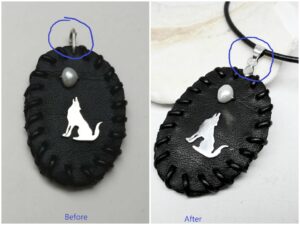
Sometimes it is about a small detail, such as a bail
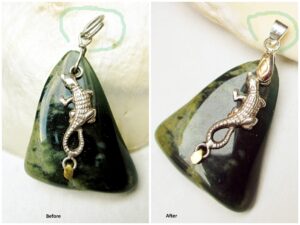
Very often there is a “grain of sand in the shoe” effect. Something is wrong, something does not add up. A small but disturbing detail.
In the past I concentrated too much on the piece itself I often attached the bail as a closing entry. Though the bail is an important finishing touch. It must be proportionate to the pendant: mechanically and esthetically
This jade stone with lizard sunbathing on it was too heavy for its tiny bail ring. And the wolf was howling at the moon which did not have enough shine. So both the lizard and the wolf received a new bail. They are still available in my shop: the lizard on jade and the howling wolf necklace. Both can be supplied on a leather chain to make the makeover complete.
Correcting past mistakes
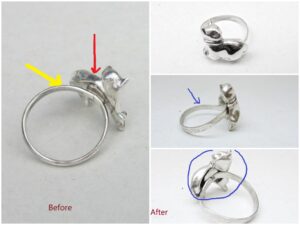
A hobby jewellery maker has to learn from mistakes. When I started making jewellery I underestimated the importance of mechanics and proportionality. For instance that the band of the ring must fit its top. A too thin band in proportion to the top makes the ring rotate on the finger. As a result the thouroughly created top goes underneath the finger and gets lost visually, getting in the way mechanically. And it is not comfortable. In rings comfort and estethics go hand by hand. The hand is the most active part of our body. So rings must not obstruct daily activities.
This cat figure has been sculpted from precious metal clay and then soldered to a 2 mm thick sterling silver band (yellow arrow). A way too thin for the quite heavy kitty. Besides the cat figure itself was too flat to align with the curve of the ring shank (red arrow). I bent the cat slightly and soldered a new, flat, irregularly curved ring band which followed the curves of the cat’s body.(blue markings on the right). As you can see they form one whole now: the cat figure and the ring.
The renewed kitty cat ring is now on sale too
New tools and techniques
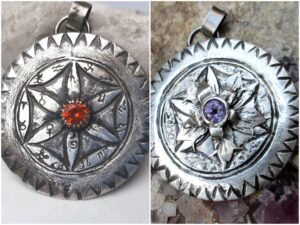
PMC in its raw state is a material which invites texturizing and engraving, even without sufficient tools and skills. I was so happy to scribble some Zodiac signs on this pendant back in the early years. But after some time they looked very primitive to me. I wanted to get rid of these ugly scratches. The best way of getting rid of unwanted texture is not to try to smoothen, but to apply new texture and new elements. So this Zodiac pendant (on the left) became a whimsical antiqued flower medaillon (on the right). The stone has been replaced too, just because I needed an orange stone for another project.
I also have a special engraving drill head now, but engraving is a seriously challenging technique which requires very firm hand and movements. Sometimes it is better to use a stamp or a pattern. Especially for pmc.
Going further upstream
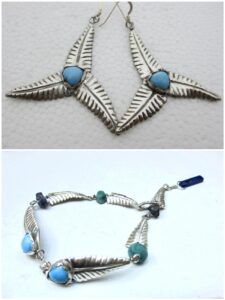
In many cases changing just a detail or texture is not enough. The piece needs a deep makeover. It means going further upstream, disassembling and reassembling the elements, changing the design completely.
When I made those earrings using the “blades” shaped from precious metal clay, with turqoise stones, I called them “The Power of air”. But their size and shape were not light at all, especially for earrings. They reminded me of the wind turbine blades – those ugly things. So I dismantled them completely and used the blades as links for a bracelet. The two turqoises were joined by other blue stones: afghanite, iolite and lapis as a finishing touch. I liked this bracelet so much that I decided to keep it myself.
Material matters
An important final remark of this long recycling experience story. The better material has been used, the more recycling freedom you have, A silver plated wire, once unwinded, can be thrown away. Solid silver wire holds at least 1 more winding session. Scratches on a silver filled surface can not be polished away. While solid silver can be polished and repolished. Again and again. Solid silver can also be remelted or used as scrap for casting. Just ensure that as much solder as possible has been removed. Solder is a big contaminator, which lowers the quality of silver. Think about it when soldering. You don’t need much solder. A perfect alignment makes the joint strong, not the amount of solder.
So, is a complete makeover possible and desirable? Yes! Even if it is not going to be a commercial success, it is something you can learn and enjoy from. Break it and make it. Re-create.
Leave a Reply