Using AI for handmade jewelry marketing: why?
A small artisan who makes things by his or her human hand, might find AI too big and threatening. Especially when one realizes that AI on a shopping platform like Etsy is not a friend of creators and their unique pieces. Etsy’s Search AI prioritizes items that sell. Say: serial production. And no matter how good your SEO and product description is, you can never compete with large shops selling one type of ring with variations like different stone or different material.
So why try to tie a warm friendship with a cold, mass-production geared monster?
“it takes all the running you can do, to keep in the same place.”
In a highly competitive market such as jewelry one needs to explore all possibilities for this one little sale. I thought, if I speak the same language as Etsy’s AI it will understand me better and give me just a little boost in search. Being a translator I know how important it is to speak the same language
My first experience in using AI for handmade jewelry marketing
So I started using Chat gpt and later Google ai studio
I needed the help of AI in two major areas
- Writing product description, titles and tags for Etsy
- Improving image quality
I will describe both here
Does AI help in writing titles, tags and descriptions?
In short, yes. It saves time, provides you some keywords, categories, technical details and other ideas, that you had not thought of. For instance I like how AI defines the style of my pieces as modern Art nouveau, brutalist or boho chique. I learned that there was a “Studio Jewelry look” popular in the 70-s. That some of my jewelry fits “vintage artisan” definition.
As to tags, they are pretty much the same as with other AI bots, like erank, alura, etc. But not all are usable for Etsy because of limited number of characters.
Whether or not they make a difference in search? When I edited my titles and tags using AI suggestions I noticed an upsurge in views. But these are not real people, but a well-known phenomenon of Etsy bots crawling.
Does it actually help with sales?
NO. At least not in my case. Some sellers on Etsy even argue that Etsy search algorhythm pushes the product back if it notices AI work.
People also point to absolutely “not-human”, repetitive, clumping and sometimes outwardly ridiculous expressions like “upgrade your style”, “elevate your collection” or “meticulously crafted”.
Like an Etsy seller said: As soon as I see the words ‘meticulously crafted’, ‘discover the charm’, ’embrace the art’, or ‘elevate your kitchen’, I run screaming for the hills.
I guess, like with machine translation, there must be some serious editing done in order to “humanize” the language. Keep the structure with the introduction paragraph containing all the factual keywords, but without these silly definitions. What I personally like is the summing-up bullet approach. Many shops use it for years. It improves readability for buyers.
AI and improving imagery
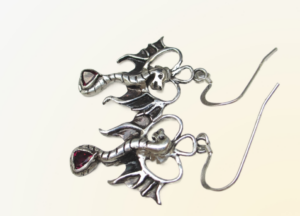
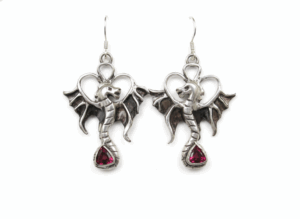
Probably the most useful job AI can do for an online jewelry shop is to improve image quality. I wrote about image enhancing earlier in my blog and this is still relevant. It is not about misrepresentation of the product, it is about showing it honestly by making the image brighter, sharper, truer to life. First thing which needs to be done is removing background by cutting off disturbing details like dirty fingers holding this tricky moving pendant.
The Nano Banana module of Google AI studio can do it pretty well, even on intricate pieces. What a difference with blurred edges produced by old software, which had to be corrected manually .
But, to be honest, in case of jewelry pieces AI does not improve photo quality as such. I remember when I had to give 5 prompts “please improve this image quality” and every time the output image strayed further and further away from the original. Until I gave up. This is a typical result of miscommunication with AI.
If you are not happy with the improvements, upload the original image once again, don’t try to recycle the “improved” version.
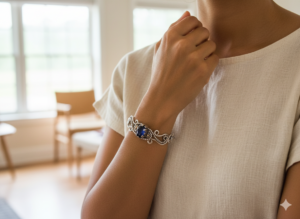
However the most exciting part of the AI image tweaking game is showing your jewelry piece on a model. This was too a topic of my blog. With years my maker’s hands did not get better. They are more aged and rugged. So I LOVE the prompt “show this piece on a model”. I love seeing how beautiful my jewelry is – can be – when worn by perfect models. And I noticed that many shops do it. Small businesses don’t have the money to hire supermodels.
What else can AI help with?
For instance, with estimating the value of the piece. All you need is upload a good image and provide some information like material and gemstone.
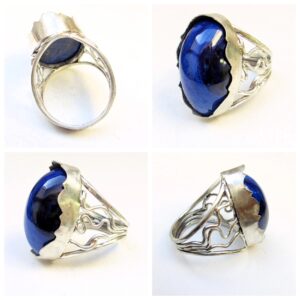
I learned (or got confirmed) some things I knew before. Like value adding factors, such as “the handmade look”, “trendy”, abundance and quality of a particular stone, craftmanship etc. And the most important value driver of all: the artist’s NAME. The same piece made by an exclusive boutique costs factor 3-5 more than exactly the same piece made by an unknown artist, like myself.
This is how AI valued this handmade ring with an absolutely unique genuine Azurite (which I am going to keep myself).
Here is exactly why my initial estimate was lower, and what specific factors elevate this piece to the $300 price point:
1. The “Artist” Factor (The biggest variable)
My initial estimate was based on the ring being an “Anonymous” vintage piece.
Anonymous: $65 – $135.
Signed/Attributed: $300+.
If this ring has a hallmark or signature inside the band from a known Modernist silversmith or a specific Studio Jeweler (common in the 1960s and 70s), the value skyrockets. The “scalloped” bezel and the specific wire construction are very reminiscent of the Brutalist or Modernist jewelry movements. Collectors pay for the name and the artistry, not just the silver and stone.
Welcome to the real world, Zilvera.
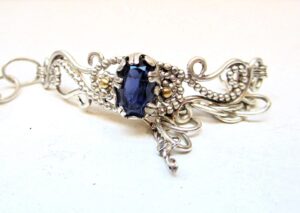
However, the AI judgment is not always a disillusion. Very often AI cheers you up, saying “wow, what a great piece of jewelry”, followed by a detailed description of what makes your piece so great.
This is what Google ai studio told me about this iolite bracelet .
This piece fits into the “Art Nouveau Revival” or “Fantasy/Elven” aesthetic. Unlike the Brutalist style of the ring, this piece is much more delicate, focusing on curvature and flow…
The focal point features intricate scrollwork (curved wire) and granulation. Granulation is the technique of soldering small spheres of metal onto the surface. (I thought it were filigree but it is granulation, thank you AI)
Mixed Metals: This is a key feature. The silver scrollwork is accented with small beads of 10k Gold. This “mixed metal” look adds significant depth and contrast, drawing the eye to the details surrounding the stone.
Valuation: Estimated Value: $325 – $425 USD
So is being human still superior?
Yes, mainly because you have to deal with human buyers. Even if AI helps you technically, it cannot make people like (and buy) your piece of jewelry. Not yet.
Like another Etsy seller said: AI default writing is what marketing sounds like when it’s averaged together. Real humans don’t write in averages; they write in voice, habit, bias, rhythm, and intention.
Since ChatGPT and other AI’s are trained on blog posts, sales copy, help articles, ad text, and SEO content, they are good at providing technical information. But you need to bring the human touch to the marketing information.
Using AI for handmade jewelry marketing, conclusions:
So, what an AI can do for you as a small jewelry artist?
- Provide accurate technical information and descriptions, analyze, estimate the value, improve the images of your jewelry pieces and maybe be more
What do you need to consider:
- Learn how to communicate: give the right prompts, specific and detailed instructions, including a list of words to avoid.
- Don’t always believe it, stay down to earth
- Humanize the marketing
- See it as a toolbox, stay authentic.
You are the creator, stay in charge
(to be continued)
Leave a Reply